
Views: 216 Author: Site Editor Publish Time: 2025-10-13 Origin: Site
Gas assist injection mold tooling (also called gas-assisted injection molding, or GAIM) is a powerful variant of traditional injection molding that injects pressurized inert gas (commonly nitrogen) into molten plastic to displace resin in thicker sections and create hollow cores or reinforce ribs. The technique enables designers and manufacturers to reduce part weight, avoid sink marks and warpage, improve cosmetic surfaces, and in many cases lower clamping pressure and cycle time.
However, not every part geometry or application is appropriate for gas assist tooling. Misapplication can lead to defects such as blow-through, gas marks, or uneven wall thickness. The challenge for design engineers and mold makers is to identify which part types are ideal candidates for gas assist, and to understand boundary conditions and trade-offs.
In this article, we explore which types of parts are best suited for gas assist injection mold tooling, how to identify good candidates versus less-ideal ones, design and material considerations, and practical guidelines for transitioning a part to gas assist.
Before diving into part types, it’s helpful to articulate the key attributes that make a part a strong candidate for gas assist. These criteria serve as a filter to guide decisions.
| Criterion | Why It Matters for Gas Assist | Rule of Thumb / Target |
|---|---|---|
| Section thickness variation | Gas displaces molten resin preferentially through thicker, lower-viscosity paths. Extreme variation (very thick vs very thin) can misdirect gas. | Moderate thick sections (2–4× average wall) are manageable. |
| Overall size / span | Larger parts benefit more from internal pressure control, warpage mitigation, and material savings. | Spanning flat panels, long rods, covers, frames. |
| Desire for hollowing / weight saving | Gas assist excels when hollow cores or ribs are desired rather than full solid cross-sections. | Aim for partial cores, not full hollowing unless structural allowances permit. |
| Cosmetic surface importance | Surface sink marks, weld lines, or visible internal stress are common defects in thick parts; gas assist can suppress them. | For parts where aesthetics or smooth finish matter. |
| Tolerance on internal void location | The designer must tolerate that the gas-displaced void will follow a “path of least resistance” and cannot be tightly constrained in small features. | Avoid fine intricate internal voids; allow control “corridors.” |
| Cavity count and mold complexity | Multi-cavity molds with widely variant cavity sizes present challenges in gas balancing across cavities. | Prefer single cavities or matched cavities of similar geometry. |
| Material suitability | The resin’s melt viscosity, thermal conductivity, and gas permeability affect gas flow and stability. | Medium-viscosity thermoplastics (e.g. ABS, PP, PC blends) are common. |
Any part meeting most of these criteria becomes a plausible candidate for gas assist injection mold tooling.
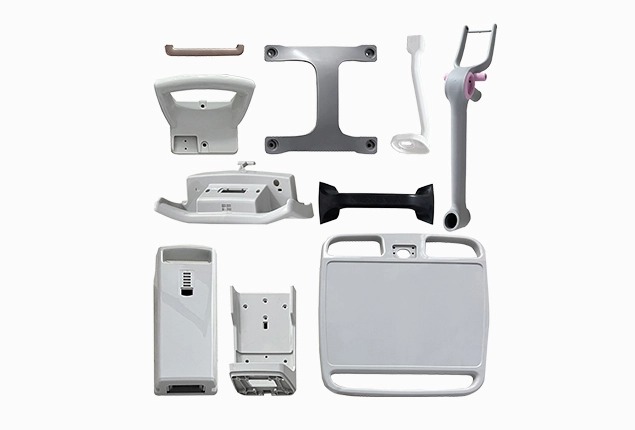
Below are six part categories that typically align very well with gas assist tooling. Each category is tied to how gas assist overcomes specific molding challenges.
Parts with elongated, tubular cross-sections—such as handles, grips, levers, or frame members—are classic and perhaps the most widely cited candidates for gas assist. The gas can core out the interior, creating a hollow backbone that preserves strength while reducing material and weight.
Reason this class fits well: The geometry naturally allows a straight path for the gas bubble; the hollow core is well tolerated structurally; and sink marks are less of a concern internally.
Examples: Automotive grab handles, garden tool handles, steering wheel rims, furniture rails.
Material savings: In many cases, 20–40% reduction in resin usage is achievable.
Because internal gas channels can run longitudinally with minimal redirection, this geometry is forgiving.
Gas assist is highly effective for large flat parts—such as doors, panels, housing covers, and equipment shells—with thick-to-thin transitions.
Why this works: Gas helps “push out” resin uniformly across the part, reducing warpage and sink marks in thick zones. External gas assist (where gas is introduced behind a surface) can help enforce flatness.
Examples: Automotive interior door panels, refrigerator side panels, appliance housings, office equipment covers.
Benefit: Better dimensional control across large spans; lower residual stress; ability to use thinner walls safely.
For flat parts, the gas network design and flow uniformity are critical — poor distribution leads to uneven packing or gas “shortcuts.”
Parts with internal ribs or reinforcement webs—e.g. frame interiors, stiffening ribs—can benefit from gas assist to reduce core density and lighten the part.
Mechanism: Gas can replace the need for dense solid fill under ribs, thereby reducing sink or internal stress while still allowing ribs to press out the shell.
Examples: Brackets, structural supports, chassis components, battery covers.
Caution: The ribs must allow gas to “crawl” around them; overly complex rib networks may cause gas flow interference.
When a part includes relatively thick bosses, inserts, or isolated islands, traditional molding would demand overpacking or localized thick sections. Gas assist can hollow them without compromising outer walls.
Use case: Mold in a thick boss to hold a screw insert but use gas to core out internal resin.
Advantage: Avoid sink and internal voids without oversizing the boss; balance outer wall aesthetics with internal voiding.
Design constraint: Bosses must connect into a gas pathway or have bleed channels.
Consumer products, housings, medical devices, and electronics casings that require minimal post-process finishing or visible sink marks benefit from gas assist.
Benefit: Gas pressure helps suppress sink, surface blemishes, and warpage, promoting better finishes straight from the mold.
Examples: Electronic enclosures, medical instrument covers, cosmetic appliance shells.
Limitation: Transparent or optically clear parts are more challenging because gas interference can affect clarity or produce gas marks.
While not strictly a “part geometry” category, production scale matters. Gas assist tooling has higher upfront complexity and tooling cost, so it is well-suited for mid-to-high volume runs where amortization makes sense.
Economic rationale: The material savings, reduced cycle times, and lower press tonnage can offset tooling complexity over many parts.
Caution: For very small, simple parts or ultra-high-precision parts, the additional complexity may not justify the gain.
Thus, the sweet spot tends to be parts in the tens to hundreds of thousands of pieces or more.
It’s equally critical to recognize when gas assist is not appropriate. Below are three types of parts for which gas assist generally underperforms.
Parts whose walls are uniformly thin (e.g. cellphone shells, thin covers) offer little internal volume for gas to penetrate. Misrouting or interference can lead to incomplete voiding or gas short circuits.
Reason: Gas has limited “breathing room” and may prematurely break through.
Better approach: Use standard injection molding, possibly with conformal cooling or microcellular foam solutions.
Gas assist inherently creates a void that follows a path of least resistance through the melt. That limits control in extremely tight, micron-scale features, especially where internal void placement or uniformity is critical.
Issue: The gas bubble can wander unpredictably relative to microstructures, causing local distortion or variance.
Use caution: For precision optical inserts, fine gear teeth, or miniature connectors, conventional molding or insert molding is often safer.
Because gas insertion and displacement can create internal gas marks or alter melt flow lines, parts requiring optical clarity (e.g. lenses, transparent covers) risk cosmetic defects that compromise their performance.
Challenge: Gas interfaces can disrupt internal gloss or uniformity.
Recommendation: Use standard molding or careful co-molding solutions; some translucent polymers with very precise gas control might work, but risk is high.
In summary, gas assist is powerful but not universal — designers should avoid relying on it for ultra-thin, ultra-precise, or optically critical parts.
Even for parts in the “good candidate” categories, success is not guaranteed without careful design and material selection. Below are key considerations.
Placement: Gas inlets (pins or slits) must be strategically located to guide the bubble through intended void paths, avoiding unwanted shortcuts or blow-through.
Sizing: Slit widths or pin clearances are typically very small (e.g. < 0.02 mm) to prevent molten plastic invasion.
Balancing: In multi-gas systems (multiple inlets), balancing flow rates and timing is critical to achieve uniform skin thickness and void consistency. Mold simulation (e.g. Moldex3D) is often used.
Flow interruption: Use of valves, throttling, or sequential gas control can enhance predictability.
Preferred materials: Thermoplastics like polypropylene (PP), ABS, PC, PBT, HDPE, and their blends are commonly used.
Melt viscosity: If the resin is too viscous, gas penetration is sluggish; if too low, gas may break through prematurely.
Thermal behavior: Materials with higher thermal conductivity help regulate skin formation and densification; gas permeability and diffusion resistance also matter.
Skin thickness: A consistent outer skin (solid plastic) is required to sustain structural and surface integrity; typically this might be 0.8–1.5 mm depending on design.
Core depth: The void core should leave sufficient residual ribs or webs for structural strength; typical core depths might be 30–60% of total section height, depending on load.
Transitions: Avoid abrupt thickness changes — taper transitions to reduce gas surging or flow interruptions.
Gas venting: Once molding completes, the gas must be vented in a controlled manner to relieve pressure — vent channels or outlets must be designed.
Avoid entrapment: Internal dead volumes or trapped pockets that cannot vent may lead to blistering or internal stress.
Sequential timing: The timing of gas injection (short-shot vs. full-shot) and hold periods must be tightly synced.
Cooling influence: The hollow core delays cooling slightly, but the outer skins cool normally; this differential must be accounted for to avoid warpage.
Because gas assist reduces required packing pressures and gate hold pressures, lower-tonnage machines or lighter molds (even aluminum) may be feasible.
However, mold strength and dimensional stability remain critical for alignment, sealing gas channels, and withstanding repeated cycling.
When transitioning a part from conventional injection molding to gas assist tooling, follow a structured evaluation and redesign approach:
Feasibility screening
Identify candidates with moderate thickness, good span, and aesthetic priority.
Exclude ultra-thin, highly precise, or optically critical parts.
Preliminary simulation & modeling
Use software (e.g. Moldex3D) to simulate gas front progression, possible gas shortcuts, and surface skin evolution.
Check for possible blow-through or dead-gas zones.
Redesign geometry where needed
Add or re-locate ribs, blend thickness transitions, open gas pathways.
Adjust boss design, merge features if possible.
Layout gas channels/inlets
Decide number, size, and position of gas pins or slits; allow sequential control if necessary.
Optimize timing & pressure profiles
Develop gas injection schedules, ramp profiles, and hold times.
Conduct experimental trials to refine.
Tooling design & venting
Incorporate vents, gas escape routes, sealing features, maintenance access.
Ensure mold alignment and robust sealing due to gas pressure.
Trial runs and validation
Produce test runs; inspect for sink, warp, dimensional consistency, internal void location, surface marks.
Iterate gas parameters or pin layout as needed.
Production ramp & monitoring
Monitor cycle stability, part-to-part variation, and gas system pressure stability.
Document optimal settings and tolerances.
Using this checklist helps prevent costly surprises or failure modes once production begins.
Here’s a comparative table showing the relative performance or trade-offs when using traditional injection versus gas assist for typical candidate part types.
| Part Type / Feature | Conventional Injection Molding | Gas Assist Injection Molding | Comments / Impact |
|---|---|---|---|
| Long tubular handle | Solid fill or structural foam—heavier, more resin, risk of sink | Hollow core, lighter weight, internal pressure support | Gas assist gives major material and weight saving |
| Flat panel with thick boss | Thick solid sections or local overpacking—warpage, sink zone | Gas core displaces internal resin, surface control | Better flatness and less residual stress |
| Structural rib network | Dense infill or thick webbing—internal stress risk | Gas can hollow under ribs, keep skin thickness | More balanced structure without overfill |
| Thin-walled shell | Very efficient in traditional mold | Gas assist offers limited gain or risk of breakthrough | Usually better left in conventional mode |
| Optical transparent cover | Good control in conventional molding | Risk of gas marks or optical distortion | Conventional preferred unless absolute control possible |
| Medium volume large part | High resin cost, longer cycle | Reduced material, faster cooling, lower tonnage | Gas assist becomes attractive at scale |
Below are distilled recommendations and warnings based on industry experience.
Begin with simulation early to visualize gas penetration and optimize pin placement.
Use incremental gas injection (staged gas) for large or complex parts to maintain control.
Overdesign skin thickness conservatively during prototyping (leave margin).
Use matched cavity geometry when doing multi-cavity gas assist molds to balance gas flows.
Control gas supply pressure stability and use clean, dry nitrogen to reduce contamination in gas lines.
Monitor cycle-to-cycle gas pressure consistency; variation leads to inconsistent voids or defects.
Keep maintenance access for gas lines, seals, and pins — contamination or wear degrade performance.
Blow-through: Gas bursts through a thin region prematurely, disrupting part fill.
Gas marks / streaks: Uneven gas fronts or partial gas paths leave visible defects on surfaces.
Dead zones or gas-starved cavities: Some part zones may never see gas reach them, leading to inconsistent core formation.
Gas intrusion into molten plastic: If pin clearance is too large or gating poorly controlled, molten plastic can invade gas channels.
Void too close to wall: Gas bubble drifts too near a wall and weakens wall integrity or causes surface dimpling.
Cycle instability: Variations in shot size, machine timing, or gas pressure cause variation in part quality.
Avoiding or mitigating these requires tight process control and iteration during prototyping.
When the question is “What types of parts are best suited for gas assist injection mold tooling?,” the clear answer is: parts that feature moderate-to-thick cross-sections, span larger spans, require internal voiding or weight reduction, demand high surface cosmetics, or carry ribbed structure and bosses—all in the context of mid-to-high production volume. The ideal candidates include tubular handles, flat panels, reinforcement-rib parts, deep bosses, and cosmetic housings. In contrast, very thin-walled parts, parts demanding ultra-precise internal features, or optically critical parts are generally poor fits.
Of course, design discipline, material selection, gas channel layout, and process tuning all play critical roles in whether gas assist truly succeeds. With thoughtful design and early simulation, many parts originally molded conventionally can be successfully converted to gas assist tooling, unlocking savings in weight, cycle time, material, and quality.
Q1: Does gas assist reduce cycle time?
Yes — by hollowing the core, less resin volume needs to be cooled, speeding solidification in thick sections. Also, pack- and hold-phase duration may shrink. But the additional gas injection and timing overhead may offset some gains, so realistic trials are needed.
Q2: Can any thermoplastic resin be used in gas assist tooling?
Most common thermoplastics (PP, ABS, PC, PBT, HDPE, etc.) are compatible, provided their melt viscosity and gas permeability are suitable. Some high-viscosity engineering resins may present difficulties.
Q3: How many gas inlets or pins should I use?
It depends on part size, geometry, and internal routing. Many designs use 1–4 gas inlets; large span parts may need distributed or staged inlets. Simulations help decide optimal number.
Q4: Is gas assist tooling more expensive?
Yes, tooling is more complex due to gas channels, sealing, control, and venting. However, material savings, lower press tonnage, reduced cycle time, and improved yield often justify the additional upfront cost for mid-to-high volume runs.
Q5: Can I retrofit an existing conventional mold to gas assist?
Sometimes yes — if the mold has sufficient thickness to add gas channels, and access for gas lines and vents can be incorporated. But many environments require full redesign for optimal performance. Simulation and structural feasibility must be assessed first.


