
Views: 186 Author: Site Editor Publish Time: 2025-10-10 Origin: Site
In modern plastics manufacturing, the constant push is toward lighter, stronger, and more cost-efficient parts. Traditional injection molding has served well for decades, but as geometries become more complex and demands for material savings intensify, alternative molding techniques are increasingly important. One of those advanced methods is gas assist plastic injection molding, a technique that leverages pressurized gas to improve part integrity, reduce weight, control warpage, and expand design flexibility. In this article, we will fully dissect what is gas assist plastic injection mold, how it works, when it is appropriate, its advantages and limitations, design and tooling considerations, simulation and process control, and finally guidelines for practical adoption.
At its core, gas assist plastic injection molding is a variation of conventional injection molding in which, after partial filling of molten resin into the cavity, a pressurized inert gas (typically nitrogen) is injected to displace or “core out” some of the plastic in thicker regions, creating hollow or semi-hollow sections within the part.
In practice:
The mold is injected with molten plastic, but not necessarily to the full cavity volume (often ~70-80% fill) .
Once the skin or near-wall region has solidified to a certain thickness, nitrogen gas is introduced via gas inlets or pins.
The gas bubble expands, pushing molten core material further toward extremities of the cavity, ensuring full contact with cavity walls, while creating a hollow interior in the thicker sections.
During cooling, the gas pressure maintains uniform pressure on the internal surfaces, compensating for shrinkage, mitigating warpage, and preventing sink marks.
After the part has sufficiently solidified, the gas is vented (or exhausted), and the part is ejected.
There are two main variants of gas assist:
Internal gas assist: The gas travels through internal gas channels or pins, creating internal hollow cores inside the plastic body.
External gas assist: Here the gas is introduced behind or adjacent to surface skins, forcing the molten resin against cavity walls—useful for high aesthetic surface requirements and suppression of sink marks on visible surfaces.
The interplay of plastic flow, gas front advance, tooling geometry, timing, and pressure control is delicate; success depends heavily on thoughtful design and process control.
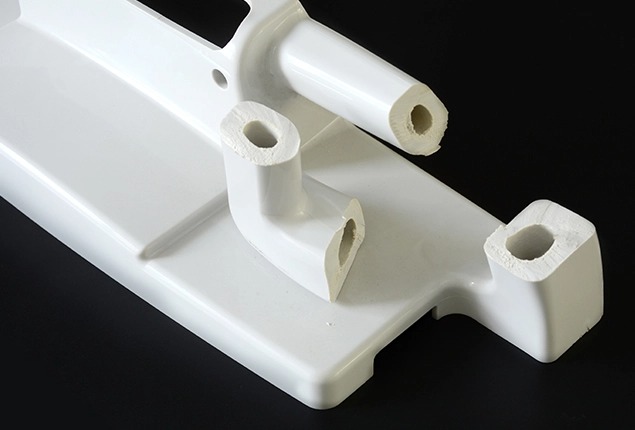
When someone asks “what is gas assist plastic injection mold”, they often implicitly want to know: why would I use that instead of conventional molding? Here are the principal advantages and use-case motivations:
By creating hollow or cored-out regions in thick sections, the gas replaces plastic that would otherwise be solid. This yields material cost savings and lighter parts, often reducing weight by 20%–40%.
Thicker sections in injection molded parts tend to cool slower, causing differential shrinkage and sink marks or warps. The internal gas pressure in the gas assist process helps mitigate those issues: the gas “pushes” on the skin, holding it against the mold, thus eliminating or reducing sink marks and warpage.
Because less plastic must be injected and less packing pressure is needed (the gas does much of the “packing” role in core regions), the required clamp tonnage is often lower. This reduces machine load, tooling wear, and energy consumption.
Hollowed sections facilitate faster heat extraction (due to thinner walls around the hollow core) and reduce thermal mass. Combined with more uniform internal pressure, this can shorten cooling phases and thereby overall cycle time.
Gas assist allows designers to include variable wall thicknesses, heavy ribs, bosses, and deep geometries in a single part rather than splitting into multiple components. It can reduce assembly or secondary joining operations.
Because the gas pressure helps push out residual dents and shrinkage at the final cooling stage, aesthetic surfaces (smooth skins, minimal sink) are more achievable with less post-processing.
Below is a comparative overview table:
| Benefit | Impact / Description |
|---|---|
| Material & weight reduction | Less plastic used in internal cores, lighter assemblies |
| Fewer defects (sink, warp) | Gas pressure counters differential shrinkage and internal stress |
| Reduced clamp tonnage | Lower injection/packing loads on the machine |
| Shorter cooling / cycle time | Faster thermal equilibration due to hollow cores |
| More complex design freedom | Combine thick and thin sections, integrate ribs and bosses |
| Better surface finish | Minimized sink marks and cosmetic defects |
These advantages make gas assist plastic injection molding particularly compelling for larger structural parts, consumer enclosures, handles, panels, and aesthetic components where weight, finish, or cost are critical.
While powerful, gas assist molding is not a universal solution. Knowing when it is applicable (or not) is essential to avoid misapplication. Here are key suitability criteria and limitations:
Parts with varying wall thickness: Thick sections that would otherwise cause sink or excessive shrinkage benefit greatly.
Large parts with long flow lengths: Because the gas can help push molten resin further, it helps maintain uniform pressure over extended geometries.
High cosmetic demand: When surface finish is critical (minimal sink marks), gas assist is advantageous.
Need for lighter weight without sacrificing rigidity: Hollow regions maintain geometry but reduce mass.
Projects where tooling cost or cycle time benefits exceed added complexity.
Multi-cavity molds with dissimilar cavities: It is difficult to manage gas flow uniformly across cavities of varying volume or geometry.
Transparent or highly clear materials: Gas assist may introduce visual imperfections ("gas lines") or interfere with optical clarity.
Extremely thin-wall parts: In ultra-thin geometries, there may be insufficient skin thickness to maintain gas integrity.
Complex control requirements: Precise gas timing, pressure, and path control is essential. Mismanagement may lead to blow-through, voids, or inconsistent walls.
Higher upfront tooling complexity and cost: Specialized gas channels, inlet pins, and venting systems add design complexity.
Material compatibility constraints: Some resins may respond poorly or unpredictably to gas core formation.
In sum, gas assist molding is most appropriate for intermediate to high-volume parts with geometry or finish challenges that standard injection molding would struggle with.
Successfully utilizing gas assist plastic injection mold demands careful design decisions in tooling layout, gas channel configuration, venting, material selection, and process control. Below are the major considerations:
The number, size, location, and orientation of gas inlets (pins) are critical. Ideally, they should target thick core sections and avoid interfering with final surfaces. Routing must balance gas flow resistance and plumbing complexity. Gas channels must encourage the gas bubble path to move centrally through molten core regions rather than hugging cooler walls.
Proper sequencing is key. Gas injection must occur after the melt skin has developed sufficient integrity but early enough that core melt is still fluid enough to be displaced. Delay timing, gas pressure ramping, and secondary gas injection phases might be needed to fully compensate for contraction during cooling.
After gas expansion and cooling, the gas must be vented cleanly without damaging the plastic. Vent paths and exhaust ports must be integrated without compromising structural integrity. Control of venting speed is also important to avoid vacuum or internal collapse during ejection.
A thin, uniform skin around the gas-inserted core is essential to maintain part stiffness and surface integrity. Walls around gas channels should avoid abrupt geometry changes or sharp corners, which may cause uneven gas propagation or localized thinning.
Resins with good melt flow and thermal stability are preferred, particularly those tolerant to shear and not overly sensitive to gas invasion. Common resins used include ABS, polypropylene (PP), polycarbonate, PBT, and HDPE.
Molds must incorporate gas plumbing, pressure controls, sealing around gas lines, and durable surfaces to tolerate pressurized gas contact. Seals and joints must manage potential leaks.
Because gas behavior is non-linear and interacts with molten resin flow, simulation tools (e.g. Moldex3D) are often necessary to predict gas advance, skin thickness, void formation, corner effects, and blow-through risks.
Here is a simplified checklist of design decisions:
| Design Aspect | Key Decision Points |
|---|---|
| Gas inlet count & positioning | Ensure coverage of thick zones, avoid interference with surfaces |
| Timing and sequence | Delay gas injection until skin forms yet core is mobile |
| Vent and exhaust design | Controlled venting to release gas post cooling |
| Skin thickness design | Maintain minimum skin thickness around core regions |
| Material choice | Select resins with favorable flow and compatibility |
| Mold plumbing & sealing | Robust gas plumbing and sealing systems |
| Simulation | Use CAE to validate gas core paths and performance |
When done correctly, these design choices turn gas assist from a theoretical advantage into a practical, repeatable manufacturing tool.
Because gas assist plastic injection mold involves tightly coupled fluid–gas–thermal interactions, process control and real-time monitoring are central to reproducibility and part quality.
CAE simulation tools can model gas penetration, skin thickness evolution, gas front speed, bubble morphology, blow-through risk, and final void distribution. This helps engineers optimize inlet placement, pressure schedules, and delays before expensive tooling trials.
Simulations can also visualize when gas might “finger” or take unintended paths through weak resistor zones, or when excessive thinning might occur near corners.
Gas injection must be precisely controlled (pressure, flow rate, ramp profile). Sudden overpressure can rupture skins; underpressure may fail to displace core melt. Multi-stage pressure profiles may be needed during filling, packing, and hold stages.
Sensors (e.g., pressure transducers, flow meters, temperature sensors) can provide real-time feedback. Some systems integrate closed-loop control to adjust gas parameters dynamically.
Key metrics include:
Wall / skin thickness uniformity
Void / gas bubble placement and integrity
Surface appearance (sink, blemishes)
Dimensional stability and warpage
Mechanical performance (stiffness, strength)
Parts are often cross-sectioned, X-rayed, or CT-scanned to verify internal cores and confirm gas behavior matched design intent.
Because gas assist has narrower process windows than standard molding, small deviations in temperature, melt viscosity, or gas timing can lead to defects. The objective is to build a robust window with sufficient tolerance margins for practical production.
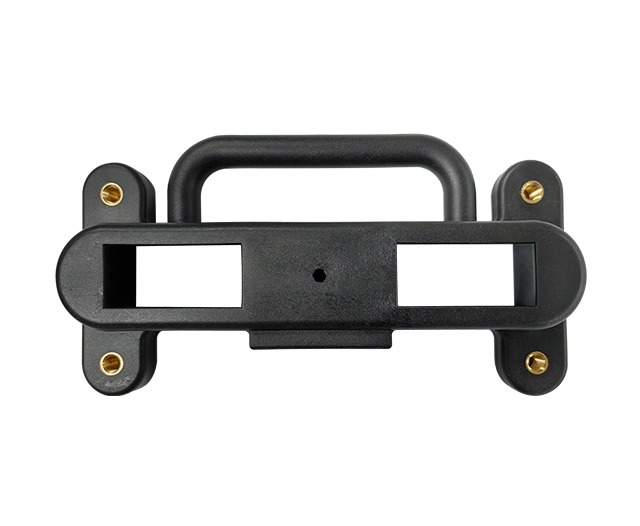
To bring the concept to life, here are illustrative use cases of gas assist plastic injection mold:
Automotive interior panels and door handles: These parts benefit from weight reduction, integration of ribs and complex shape, and high aesthetic finish.
Consumer appliance housings: Enclosures with thick-ribbed sections can avoid sink marks and improve cosmetic surfaces.
Large covers and panels: Using gas assist, large parts can be molded without overly large tonnage presses because internal voids reduce pressure requirements.
Medical device enclosures: Where stiffness, weight, and cosmetic surface are all critical.
Sporting goods / handles: Gas assist can deliver hollow grips or handles with internal stiffening.
Each scenario typically leverages the benefits we discussed earlier: lighter weight, defect mitigation, better appearance, and cost savings over large part assemblies.
To fully answer “what is gas assist plastic injection mold”, one must also acknowledge and manage the risks inherent to the technology.
If gas pressure exceeds the strength of the semi-solid skin, the gas can burst through, causing surface defects or failure. Mitigation: careful pressure ramping, robust skin thickness, and real-time monitoring.
Gas may penetrate unevenly or follow preferential paths, leaving voids or thin areas. Mitigation: simulation, multiple gas injection points, resistor ribs to guide gas, tuned delay and flow profiles.
Adding gas channels, vents, and plumbing increases mold complexity and cost. Mitigation: involve mold and process engineers early, balance benefits vs cost, prototype small sections first.
Gas assist often requires tighter control over temperature, viscosity, and timing. Mitigation: extensive design-of-experiment (DOE) studies, process robustness testing, and sensor-based feedback.
Some resins, especially optically clear or low-viscosity materials, may not behave predictably in gas assist. Mitigation: qualify resins early, test trial runs, and avoid materials prone to gas-induced defects.
By addressing these risks proactively, manufacturers can harness gas assist’s benefits without falling prey to its pitfalls.
Here’s a phased approach for integrating gas assist plastic injection mold into your product development process:
Feasibility Study & ROI Analysis
Identify candidate parts (thick sections, cosmetic needs, weight sensitivity).
Estimate material savings, cycle time gains, tooling overhead.
Validate whether the benefits justify the added complexity.
Conceptual Design & Simulation
Redesign part geometry for gas assist (skin thickness, gas path planning).
Run CAE/gas-assist simulation to validate gas core behavior and optimize inlet layout.
Prototype Tooling or Test Sections
Build small test molds or partial sections to validate gas behavior.
Run trials to refine gas timing, pressures, and venting.
Full-Scale Tooling & Process Development
Integrate gas plumbing into full mold.
Run DOE tests to find optimal process window.
Validate repeatability and robustness under actual manufacturing conditions.
Quality Assurance & Production Scaling
Establish quality control metrics (wall thickness, cross-sections, appearance).
Monitor key sensors in production runs and apply feedback tuning.
Document process, maintenance, and failure modes.
Throughout this roadmap, early collaboration among design engineers, mold makers, and process engineers is critical to avoid costly rework or failure modes later.
In summary, gas assist plastic injection molding is a specialized evolution of injection molding that introduces pressurized gas into partially filled molten plastic to displace core material, creating hollow sections within parts while maintaining strong skins and attractive surfaces. It offers compelling benefits: material savings, lighter parts, fewer defects (sink, warpage), lower clamping forces, improved cycle times, and greater design flexibility.
However, it is not without its challenges. Proper design, gas control, venting, simulation, and quality monitoring are essential to avoid defects such as blow-through, uneven gas penetration, or fragile walls. It suits applications where traditional molding struggles—especially for medium-to-large structural or aesthetic parts with complex geometries.
Q1: How much weight reduction can gas assist molding provide?
The weight reduction depends on the geometry and how much of the part you hollow out, but practical reductions of 20% to 40% are common in well-designed parts using gas assist techniques.
Q2: Can transparent or optical parts be made via gas assist?
Transparency is challenging, because gas assist may introduce visual defects like “gas lines” or core boundary marks. Highly clear parts (e.g. light pipes) are less ideal candidates for gas assist molding.
Q3: Is gas assist molding more expensive than conventional injection molding?
Upfront tooling cost is usually higher due to gas plumbing, channels, and control systems. However, material savings, energy efficiency, lower clamp tonnage, and reduced defects can offset the investment in many cases.
Q4: What types of parts are best suited for gas assist plastic injection mold?
Parts with mixed wall thicknesses, aesthetic surfaces, structural panels, handles, covers, enclosures, or large molded shapes with both thin and thick zones are often good candidates. Parts that are too thin, optically critical, or requiring multi-cavity mismatch tend to be less suited.
Q5: What simulation tools help in gas assist design?
CAE tools like Moldex3D offer modules for gas-assisted injection molding, allowing designers to simulate gas penetration, bubble expansion, skin thickness, and blow-through risk before cutting steel.
Q6: What are the common failure modes in gas assist molding and how can they be avoided?
Blow-through / rupture: Use controlled pressure ramp, ensure sufficient skin strength.
Uneven gas propagation / fingering: Use multiple gates, resistor ribs, optimized inlet layout.
Wall thinning in corners: Improve geometry, ensure balanced skin thickness.
Insufficient gas venting: Provide adequate exhaust paths and vent control.


