Views: 0 Author: Site Editor Publish Time: 2026-08-31 Origin: Site
Choosing the wrong multi-material manufacturing process carries massive stakes. Tooling modifications run incredibly expensive, and sudden production delays quickly kill your time-to-market. Product designers and procurement teams constantly face a difficult balancing act. You usually struggle to weigh heavy upfront tooling costs against long-term piece prices and cycle time efficiency. This friction often peaks when shifting parts from initial prototypes to full-scale mass production. While both manufacturing processes achieve similar physical results by permanently bonding two distinct materials, your optimal choice strictly depends on exact production volume, tight precision requirements, and strict budget constraints. In this guide, we break down the core mechanics of each approach. You will learn how to evaluate material compatibility, compare production throughput, and establish a clear framework for selecting the right molding strategy for your next project.
Overmolding is typically a two-step process utilizing standard injection molding machines; it offers lower upfront tooling costs but requires longer cycle times and higher labor/handling costs.
2K Injection Molding (Two-Shot Molding) occurs in a single, highly automated machine cycle. It requires significant upfront tooling investment but delivers ultra-low cycle times and superior precision for mass production.
The Decision Catalyst: Volume dictates the choice. Over molding is generally cost-effective for low-to-medium volumes (under 50,000 units), while a 2K mold provides ROI primarily at high production volumes (100,000+ units).
Material Science: Both methods require careful evaluation of chemical adhesion and mechanical interlocking between the substrate and the overmold material.
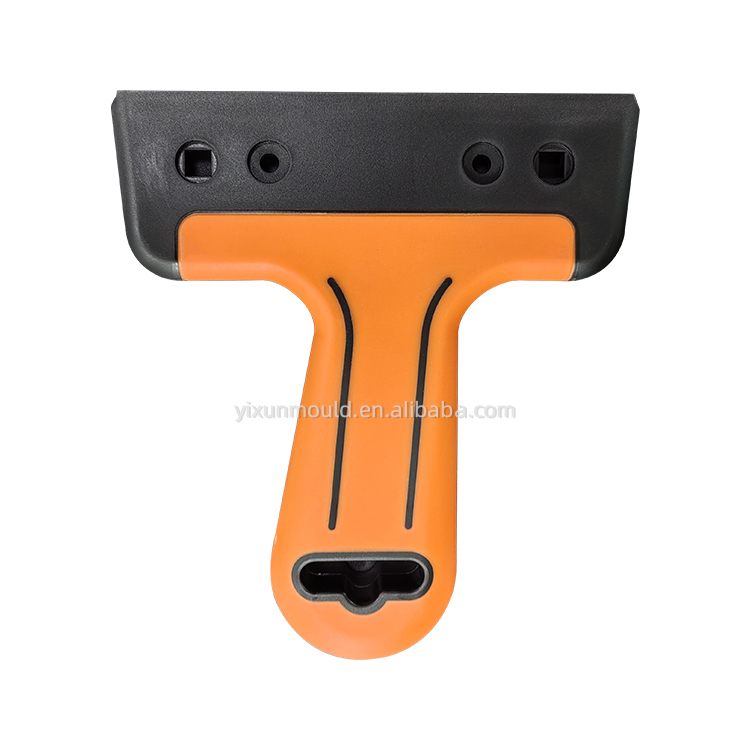
The standard two-step approach relies on sequential operations. First, you inject a rigid plastic substrate into a conventional mold. The machine cools the part until it solidifies. Next, operators or robotic arms eject the substrate. They physically transfer this part into a secondary mold cavity. Finally, the machine injects the second material directly over the rigid base. Manufacturers frequently use a softer thermoplastic elastomer (TPE) for this outer layer. This creates a comfortable grip or a protective seal.
Implementing this workflow introduces a few practical realities. The transfer phase exposes the warm substrate to ambient air. Rapid heat loss occurs. This temperature drop can weaken the final chemical bond. Manual handling also creates contamination risks. Dust, oils, or misalignments can easily compromise the final assembly. Despite these risks, over molding remains a highly accessible process. It utilizes standard machinery already present on most factory floors.
Unlike the two-step method, the single-cycle process keeps everything entirely enclosed. A specialized machine injects the primary material to form the substrate. Instead of ejecting the part, the mold dynamically adapts. The platen rotates 180 degrees, or internal cores retract to open a new cavity space. The machine immediately injects the second material. The substrate remains hot and perfectly positioned throughout the entire sequence.
This automated flow demands highly engineered tooling setups. Facilities must invest in specialized dual-barrel injection machines. These machines feature distinct nozzles and independent temperature controls for each polymer. Building these complex systems requires deep engineering expertise. The molds contain intricate moving parts, precise shut-offs, and advanced cooling channels. Consequently, establishing this production line takes more time and engineering oversight than traditional setups.
Capital expenditure varies wildly between these two methods. Creating two standard molds costs significantly less upfront. Toolmakers design these standard cavities quickly and efficiently. Conversely, engineering a complex rotary or core-back 2K mold requires a massive financial commitment. The intricate mechanics and tight tolerances drive up the initial price tag substantially.
However, you must analyze this alongside unit cost. An inverse relationship exists here. The single-cycle method drastically reduces the per-part cost over time. It eliminates all manual handling, secondary labor, and separate storage needs. As production volume scales, the incredibly low piece price rapidly offsets the high initial tooling investment.
Operational speed dictates factory efficiency. The automated two shot molding process completely eliminates intermediate cooling stages. It skips the physical transfer steps entirely. Because the part never leaves the machine, operators effectively halve the total cycle time. You can produce twice as many components in a single shift. Traditional methods always hit a bottleneck during the transfer and secondary heating phases.
Part consistency remains a critical metric for quality assurance teams. Single-cycle systems minimize alignment errors almost perfectly. You rarely see flash or short shots because the substrate stays locked into its original position. The secondary clamp force seals the cavity flawlessly. Meanwhile, transferring parts physically carries inherent risks. Placing a substrate into a second cavity often leads to slight misalignments. Even a microscopic shift can cause flash, uneven wall thickness, or failed seals.
Process Comparison: Tooling, Speed, and Precision
Feature | Standard Two-Step Process | Single-Cycle (2K) Process |
|---|---|---|
Tooling CapEx | Low to Moderate | High to Very High |
Piece Price | Higher (includes manual labor) | Lower (fully automated) |
Cycle Time | Slower (includes cooling/transfer) | Ultra-fast (continuous loop) |
Defect Risk | Moderate (alignment issues) | Very Low (locked in place) |
Successfully joining two plastics relies heavily on matching their polymer families. You cannot simply inject any elastomer over any rigid plastic. For example, an ABS substrate pairs exceptionally well with a TPU overmold. Their molecular structures interact favorably. When heated, the boundary layers interdiffuse. They entangle at the microscopic level to form a permanent bond.
Temperature plays a massive role in this chemical reaction. The single-cycle method retains the latent heat of the freshly molded substrate. When the second melt hits this warm surface, the molecules fuse aggressively. This retained heat reliably yields a stronger chemical bond. Transferring a cooled substrate simply cannot replicate this thermal advantage without secondary pre-heating stages.
Engineers cannot always rely purely on chemical adhesion. Sometimes, product requirements force you to pair incompatible polymers. When chemical affinity remains marginal, you must implement risk mitigation strategies. This is where multi material molding expertise becomes vital.
You must design mechanical interlocks directly into the rigid substrate. These physical features physically anchor the secondary layer in place. Common practices include:
Undercuts: Creating lips or grooves where the softer material wraps and locks.
Through-Holes: Allowing the second melt to flow through the substrate and rivet itself on the opposing side.
Ribs and Textures: Increasing the total surface area to maximize frictional grip.
Certain scenarios make the traditional two-step approach the undisputed champion. It fits perfectly into specific niches where extreme automation provides no real value. You should deploy this method for:
Low-to-Mid Volume Manufacturing: When your total run size stays small, the high tooling cost of advanced systems makes no sense.
Prototype Bridging: Testing market fit requires fast, affordable tooling before committing to massive production runs.
Metal Inserts: You frequently need to encapsulate threaded metal fasteners, stamped metal frames, or hand tool shafts. Encapsulating pre-manufactured metal always requires a manual or robotic placement step first.
High-end automation shines when scale and precision dominate the project requirements. The single-cycle process dominates specific global industries. You should leverage this technology for:
Consumer Goods: Products like high-end toothbrushes, multi-color razor handles, and rugged power tool housings demand massive daily volumes.
Medical Devices: Surgical instruments and wearable monitors require strict hygiene. Eliminating human handling removes contamination risks. It also guarantees flawless hermetic seals.
Automotive Components: Dashboard controls, multi-color interior trims, and backlit buttons need perfect cosmetic finishes. The continuous cycle guarantees zero flash and perfect alignment.
Your procurement team needs a reliable evaluation lens. The decision always comes down to math. You must calculate the exact unit volume where cycle time savings offset the premium tool price. For example, if an automated tool costs $40,000 more than two standard tools, but saves $0.40 per part in labor, your break-even point sits at 100,000 units. Anything beyond that threshold generates pure profit. If your product life cycle projects only 30,000 units, the traditional two-step route wins easily.
Financial models mean nothing if the physical design fails. You must assess design complexity early. Does the specific geometry allow for a rotating platen? Can internal cores retract without compromising the part's structural integrity? Some highly complex, deep-draw geometries physically block rotation. If the mechanics fail the DFM check, a manual two-step process might be your only physical option.
Buyers must audit supplier capabilities ruthlessly. Many facilities claim they handle complex projects. However, you must ensure the injection partner operates actual in-house dual-barrel machinery. Some suppliers simply plan to use standard machines for manual transfers while charging premium rates. Always verify their equipment list.
Your best next step involves direct engineering collaboration. We highly recommend submitting your 3D CAD files to a qualified manufacturing partner. Request a comprehensive DFM analysis and a detailed cost-benefit breakdown. Comparing the overmolding vs 2K injection molding pathways specifically for your geometry prevents expensive mistakes before you lock in a final budget.
The debate between these two processes rarely focuses on which is objectively better. Instead, it revolves around aligning the technology with your project's unique scale, budget constraints, and precision requirements. Low-volume runs and metal inserts naturally favor traditional two-step setups. Conversely, massive production scales demand the speed and automated precision of single-cycle systems. Conduct a rigorous break-even analysis early in your planning phase. Prioritize meticulous material selection and DFM reviews alongside an experienced manufacturing partner. Taking these deliberate actions prevents costly tooling reworks, eliminates production bottlenecks, and guarantees a successful product launch.
A: The typical threshold usually falls between 50,000 and 100,000 units. The exact number depends heavily on part complexity and labor rates. At this volume, the rapid cycle times and zero-labor assembly begin to offset the high upfront capital required for the specialized tooling.
A: Yes, both processes utilize identical material families, such as pairing rigid ABS with soft TPU. However, the single-cycle process often allows for slightly different melt temperature strategies. The continuous cycle retains substrate heat, enhancing chemical adhesion.
A: Yes, inserting a metal component and injecting plastic around it is standard practice. However, industry professionals refer to this as insert molding rather than the single-cycle automated process, which strictly involves injecting two separate polymers simultaneously.
A: Bonding dissimilar plastics permanently makes end-of-life recycling very difficult. Recycling facilities struggle to separate the fused polymer layers. To improve sustainability, engineers sometimes try to use polymers from the same primary family to ensure easier downstream processing.