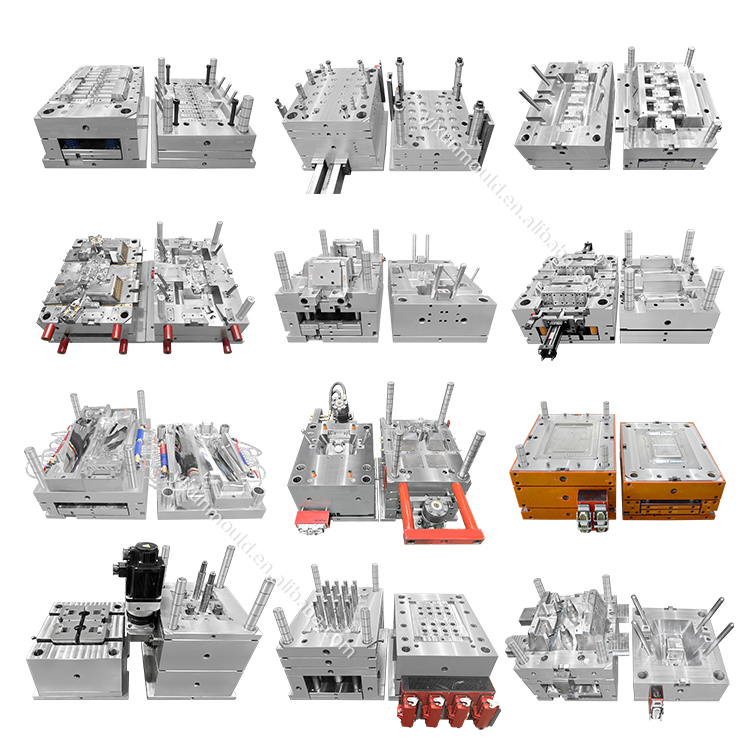
| Quantity: | |
|---|---|
YIXUN mold
8480419090
This is the simplest and most cost-effective mold configuration.
1 Cavity (the second "1"): The mold produces one single part per injection cycle. Ideal for low to medium volume production, large parts, or initial prototyping/pilot runs.
1 Mold (the first "1"): It is a single, standalone mold tool. This is in contrast to a "family mold," where multiple different parts are made in one shot.
This covers a vast range, which influences mold design:
Examples: Appliance housings, containers, tool handles, storage bins, kitchen utensils, bathroom accessories, etc.
Design Implications: Molds often require good surface finish (textured or polished), ergonomic considerations, and features for assembly (snap-fits, living hinges, ultrasonic welding pads).
The mold maker must adjust steel, hardening, and cooling design based on your material.
| Material | Key Properties | Mold Design Implications |
|---|---|---|
| PP (Polypropylene) | Semi-crystalline, good chemical resistance, flexible, can have living hinges. | • Requires excellent cooling for crystallinity control. • Draft angles critical for ejection (shrinkage). • Simpler gating; pin or edge gates common. |
| ABS | Amorphous, strong, good surface finish, can be plated/painted. | • Hotter molds for better surface finish (reduces weld lines, gloss). • High polish or specific texture on mold surfaces. • Venting important to avoid burn marks. |
| PVC | Amorphous, corrosive when melting, thermal sensitivity. | CRITICAL: Must use corrosion-resistant mold steels (e.g., Stainless Steel SS420, SS316). • All cooling channels must be corrosion-proof. • Venting and thermal control vital to prevent degradation. |
| Engineering Materials (e.g., Glass-filled Nylon, PBT) | Abrasive, high shrinkage. | • Requires wear-resistant, hardened mold steels (e.g., H13, S7 with nitriding). • Robust gating (cashew or submarine) to handle abrasion on pins. • Precise temperature control. |
What it is: The channel that transports molten plastic from the machine nozzle to the cavity is cooled and ejected with the part as waste (or recycled).
Advantages for your project: Lower mold cost, easier color/material changes, good for large parts (less pressure drop), and suitable for all your listed materials, especially heat-sensitive PVC.
Disadvantages: Material waste (runner must be recycled or discarded), longer cycle time (runner cools), and adds secondary separation step.
This refers to the tool steel selected to build the mold. The choice is critical for mold life, part quality, and cost.
P20 / 1.2311: General-purpose, pre-hardened. Good for 100k-500k cycles of PP/ABS. Most common for household product prototypes/short runs.
H13 / 1.2344 (Hot Work Steel): Excellent toughness and thermal fatigue resistance. Used for higher volumes (500k-1M+ cycles) and engineering materials. Can be hardened and polished.
Stainless Steel (SS420, SS316): Mandatory for PVC and for products requiring a perfectly rust/corrosion-free mold surface (e.g., medical, optical, food contact). Higher cost.
S7 / 1.2343 (Shock Resistance Steel): Used for high-wear areas like slides, lifters, and cores, especially with abrasive materials.
Design for Manufacturability (DFM) Review: The mold maker analyzes your 3D part model, suggests draft angles, wall thickness, gate locations, ejection strategy, and material suitability. This step is crucial to avoid costly mold changes.
Mold Design & Quotation: They create detailed mold layouts (2D/3D), specifying steel type, cooling line design, ejection system, runner type, and supplier standards. A fixed-price quote and timeline are provided.
Mold Manufacturing (Key Steps):
CNC Machining: Roughing and finishing of mold cores and cavities.
Heat Treatment (if required): Hardening of steels like H13 for durability.
Electrical Discharge Machining (EDM): For complex geometries, textures, and sharp corners.
Precision Grinding & CNC Milling: For slides, lifters, and guides.
Polishing/Texturing: Achieving the desired part surface finish.
Assembly & Fitting: Putting all components together with high precision.
Sample Testing (T1 Shots): The mold is trialed on an injection molding machine. Parts are measured and inspected.
Mold Adjustment & Final Approval: Based on T1 results, minor adjustments (e.g., gate size, cooling) are made. Upon your approval, the mold is finalized.
Can you provide a formal DFM report?
What is the exact grade/type of steel you will use for each mold component?
What is the expected mold life (number of cycles) based on the steel choice?
What is your standard warranty or guarantee on workmanship?
Can you handle the initial sampling and provide a first-article inspection report?
What are the payment terms (e.g., 30/40/30)?
Cost: For a 1*1 cold runner mold for a medium-sized household product (e.g., a lunchbox lid), costs can range from $5,000 to $20,000+. Key drivers: part size/complexity, steel choice (stainless steel adds ~30-40%), and surface finish requirements.
Timeline: 6 to 12 weeks from approved design to first samples, depending on complexity.
For a 1*1 cavity, cold runner mold for household products in PP, ABS, or PVC, you are looking at a standard, well-understood project for any competent mold maker. Your critical decision points are:
Finalize your material first (PVC dictates stainless steel).
Define your volume/lifetime needs to choose the right mold steel (P20 vs. H13).
Invest in a thorough DFM to ensure the part design is optimized before steel is cut.